

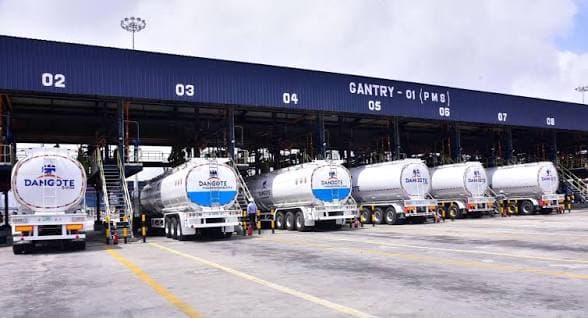
Dangote Petroleum Refinery has abandoned its five-day EBOB-based petrol pricing model and returned to fixed gantry and coastal prices in a move aimed at stabilising and controlling Nigeria’s downstream market amid volatility in the European gasoline benchmark. Industry sources have told Petroleumprice.ng that the decision is also intended to prevent marketers from taking advantage of frequent price movements, which reportedly created instability and affected the refinery’s daily product load-out.
The volatility associated with the European gasoline benchmark, EBOB, reportedly made it increasingly difficult for the refinery to maintain market stability under the benchmark-linked arrangement. By returning to fixed gantry and coastal prices, Dangote Refinery aims to regain greater control over domestic pricing, limit market disruptions caused by frequent international price movements and ensure more predictable product evacuation, industry sources told Petroleumprice.ng.
Dangote Refinery had introduced the EBOB-based pricing structure when it commenced sales through its consortium marketers. Under the arrangement, petrol prices were determined using a five-day average of the European gasoline benchmark, allowing changes in international product prices to influence the refinery’s domestic selling price.
However, the arrangement reportedly exposed the local market to frequent price adjustments as EBOB fluctuated. When the benchmark declined, marketers had room to reduce their purchase and selling prices, while upward movements could quickly increase their replacement costs. This made pricing less predictable for marketers, depot operators and bulk buyers, with rapid changes creating uncertainty over when to purchase, how much to lift and the prices at which products could subsequently be sold.
An industry source familiar with the decision told Petroleumprice.ng that some marketers were taking advantage of the benchmark's volatility, with the resulting price movements affecting the refinery's loading operations.
“We returned back to fixed gantry price because marketers are taking advance of EBOB volatility hereby affecting our load out,” the source said.
The concern, according to the source, was not simply that petrol prices were changing, but that the pace and extent of the changes were creating opportunities for marketers to take advantage of price differences. With the five-day EBOB average determining the applicable price, movements in the benchmark could trigger rapid adjustments in the wholesale market. This reportedly encouraged speculative buying and selling behaviour, contributed to market manipulation concerns and made it more difficult for the refinery to maintain predictable daily truck-out volumes.
The scale of the price movements was evident on October 30, when Dangote consortium marketers reduced their petrol gantry price from ₦1,265 to ₦1,210 per litre. The ₦55 reduction represented a 4.35 per cent drop in a single day, following a decline in EBOB. The adjustment quickly influenced the wider wholesale market, with several Lagos depots cutting their petrol prices by as much as ₦40 per litre from the previous day's closing levels.
While the price reduction intensified competition and offered lower wholesale prices to buyers, the refinery's management reportedly viewed the rapid adjustments as a source of instability. Frequent price changes could leave marketers reassessing their purchase decisions, delay lifting commitments and create uncertainty around the volume and timing of product evacuation. For the refinery, the reported effect on daily truck-out operations became a key concern, prompting a reassessment of the EBOB-linked model.
The return to fixed gantry and coastal prices is therefore intended to reduce the immediate impact of EBOB fluctuations on domestic transactions, provide marketers with greater price certainty and restore more predictable loading operations. Rather than allowing the five-day international benchmark average to drive frequent changes in the refinery's selling price, the fixed-naira arrangement gives customers a stated price for their lifting and purchasing plans.
In a notice to customers, Dangote Refinery announced a new petrol gantry price of ₦1,300 per litre and a coastal lifting price of ₦1,676,250 per metric tonne, effective from midnight on Tuesday, November 3, 2026. The refinery also suspended loading ahead of the new pricing arrangement, stating that all petrol loadings from 12:00 a.m. on November 3 would be billed at the revised rates.
The shift represents a significant adjustment to the refinery's commercial approach through its consortium marketers. Beyond setting a new price, the decision is aimed at addressing the operational consequences of benchmark volatility, limiting opportunities to exploit rapid price movements and improving consistency in product evacuation. The effectiveness of the fixed-pricing arrangement will ultimately be measured by whether it restores stability to marketers' lifting activities and supports more predictable daily truck-out volumes.