

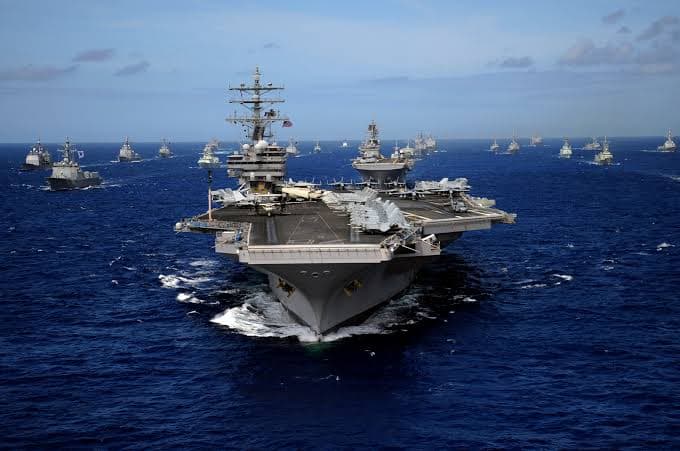
The United States is deploying additional warships and thousands of military personnel to the Middle East as diplomatic efforts to resolve its conflict with Iran stall over disagreements about Tehran’s nuclear programme, raising fresh concerns about global oil supplies and shipping security.
According to a report published by Gulf News, the deployment involves the USS Theodore Roosevelt aircraft carrier strike group and the USS Makin Island amphibious group, with approximately 9,000 sailors and Marines expected to be involved.
The USS Theodore Roosevelt departed San Diego on September 27 and is expected to replace the USS George Washington, which has been operating in the region. The deployment expands Washington’s military capabilities as President Donald Trump weighs his options amid continuing tensions with Tehran.
However, the movement of additional naval forces does not, by itself, confirm that the United States has ordered fresh military strikes against Iran.
The latest military buildup comes as negotiations remain deadlocked over Iran’s enriched uranium stockpile, sanctions relief and regional security. Tehran has refused to transfer its enriched uranium abroad, insisting that the material is a national asset and that Washington must take steps to rebuild trust before negotiations can resume.
Iranian Supreme National Security Council Secretary Mohsen Rezaei reportedly told visiting Pakistani army chief Field Marshal Asim Munir that Tehran would not surrender any of its enriched nuclear material. Iranian President Masoud Pezeshkian has also rejected negotiations conducted under military threats, while officials have demanded sanctions relief and an end to the US maritime blockade.
Washington, meanwhile, maintains that any agreement must prevent Iran from developing nuclear weapons. Tehran denies seeking to build an atomic bomb, leaving the two sides divided over uranium enrichment and the conditions required for a lasting settlement.
For the international oil market, the impasse presents a significant supply risk because of the potential consequences for crude exports from the Gulf and shipping through the Strait of Hormuz, one of the world's most important energy transit routes.
Any renewed confrontation that disrupts tanker movements or damages regional energy infrastructure could tighten available supplies, increase freight and insurance costs, and intensify volatility in crude oil prices. The scale of any market impact would depend on the duration and extent of the disruption.
The risks extend beyond crude exports. Threats to regional shipping and critical infrastructure could affect refined petroleum product movements and other commercial activity across the Gulf, increasing uncertainty for energy traders, refiners and import-dependent markets.
Pakistan has played a central role in mediation efforts, while Qatar and Oman have also maintained diplomatic channels. However, previous initiatives have failed to resolve the key disagreements over uranium enrichment, sanctions and regional security.
The additional US naval deployment gives Washington greater operational flexibility, including the capacity to conduct air operations and protect shipping. Nevertheless, diplomatic engagement remains ongoing, and the military movements should not be treated as confirmation that another round of strikes is imminent.
For Nigeria, sustained instability in the Gulf could have implications for crude export earnings and domestic fuel costs. Higher international crude prices may support government revenue, but they could also raise the cost of imported refined products and increase replacement costs for local refiners and petroleum marketers.
The eventual effect on Nigeria's downstream market would depend on international product prices, the naira-dollar exchange rate, freight costs, domestic refining supply and competition among suppliers.
The immediate focus for oil market participants remains whether diplomatic efforts can bridge the divide between Washington and Tehran, or whether the expanding military presence will increase the risk of renewed conflict in a region central to global energy supply.