

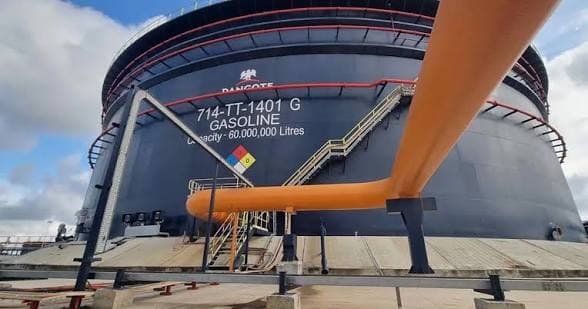
The Federal Government has described the Dangote Petroleum Refinery as a strategic industrial asset capable of accelerating Nigeria's manufacturing growth and supporting the country's ambition of building a $1 trillion economy, as the company disclosed that the facility will process approximately 2.5 percent of globally traded crude oil when it reaches full operational capacity.
The endorsement came during a visit by the Minister of State for Industry, Trade and Investment, John Enoh, to the refinery, Dangote Petrochemicals and Dangote Fertiliser Limited in Lagos, where he said the integrated industrial complex represents one of Africa's most significant private sector investments and a model for Nigeria's industrial transformation.
According to the minister, the refinery has reshaped Nigeria's position in the global petroleum market by reducing reliance on imported refined products while positioning the country to supply petroleum products to international markets.
He noted that recent disruptions in global energy supply highlighted the refinery's strategic importance, as Nigeria was able to export refined petroleum products to destinations, including the Middle East, despite instability affecting international fuel markets.
During the visit, President of the Dangote Group, Aliko Dangote, said the refinery's planned 700,000 barrels-per-dayprocessing capacity would account for about 2.5 percent of global crude oil trade, while also matching roughly 10 percent of the total refining capacity in the United States.
Dangote stressed that sustainable industrialisation depends more on stable government policies than incentives, arguing that policy consistency remains one of the strongest factors influencing investment decisions.
He said successful domestic businesses provide confidence for foreign investors by demonstrating that the operating environment supports long-term industrial investment.
As an example, Dangote cited the recent successful issuance of an unsecured and unrated bond by Dangote Industries, which was priced below Nigeria's sovereign benchmark yield, describing it as evidence that credible Nigerian companies can mobilise long-term financing from the domestic capital market.
Reflecting on the refinery's development, he described the project as the biggest financial undertaking of his career, saying it was delivered despite challenges including the COVID-19 pandemic, exchange rate volatility and widespread scepticism from lenders over its completion.
According to him, the successful execution of the refinery has created a benchmark that could encourage more large-scale industrial investments across Nigeria and the African continent.
Enoh also addressed concerns previously raised about the refinery's single-train processing configuration, explaining that scheduled maintenance had not disrupted production and that operations continued throughout the maintenance period.
He added that the Federal Ministry of Industry would continue engaging Dangote Industries through its Industrial Revolution Working Group and ministerial consultations to address challenges confronting manufacturers, particularly access to affordable long-term financing.
The minister said the collaboration aligns with Nigeria's industrial policy, which targets increasing manufacturing's contribution to the country's Gross Domestic Product to about 20 percent by 2030 and 25 percent by 2035, noting that stronger partnerships between government and major industrial investors will be essential to achieving those objectives.