

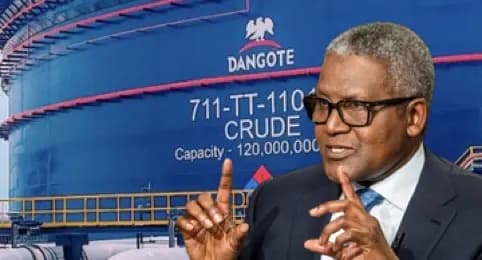
Africa’s richest businessman, Aliko Dangote, is considering Kenya as the preferred location for a proposed $17 billion oil refinery project expected to process 650,000 barrels of crude oil per day, in what could become one of East Africa’s largest downstream investments.
Dangote disclosed that the Kenyan city of Mombasa currently holds a strategic advantage due to its deep seaport infrastructure and larger fuel demand compared to neighbouring Tanzania, where the refinery was initially expected to be sited.
The development follows recent concerns raised by Tanzanian President Samia Suluhu Hassan, who reportedly expressed dissatisfaction over earlier announcements suggesting the refinery would be built along Tanzania’s coastline without prior consultation.
Speaking in an interview with the Financial Times, Dangote explained that Kenya’s stronger commercial market and maritime access make it a more attractive option for the refinery project, adding that crude supply would not necessarily depend on pipeline infrastructure from Uganda since feedstock could also be delivered through shipping routes.
According to him, the final direction of the investment now largely depends on discussions with Kenyan President William Ruto, particularly regarding land availability, regional financing support and market protection policies.
Dangote argued that large-scale refineries require protection from unfair competition caused by the dumping of cheap imported petroleum products from international markets, especially from suppliers in Russia and India.
He added that if agreements are reached quickly, construction could commence before the end of the year, although Tanzania still remains an alternative should ongoing issues be resolved.
The proposed East African refinery mirrors the scale of Dangote’s Lagos refinery, which currently processes 650,000 barrels per day and has emerged as one of the world’s largest single-train refining facilities.
The refinery has significantly reshaped Nigeria’s downstream petroleum market by reducing reliance on imported refined products and improving domestic supply stability.
Industry operators say the facility has also expanded exports of aviation fuel and fertiliser across Africa and into international markets, particularly amid recent disruptions in global energy trade linked to tensions around the Strait of Hormuz.
Dangote reportedly noted that volatility in global oil and fertiliser markets has boosted profitability across refining and petrochemical businesses worldwide, including his own operations.
He also disclosed plans to expand the Lagos refinery’s capacity to approximately 1.4 million barrels per day within the next 30 months, a move that would position the facility among the largest refining complexes globally.
According to Dangote, Africa must begin investing aggressively in local industrial capacity rather than depending heavily on imported petroleum products and foreign processing infrastructure.
Meanwhile, the Nigeria Employers’ Consultative Association has criticised the latest refinery rehabilitation agreement signed by the NNPCL with Chinese firms, warning that the country risks repeating years of failed refinery revamp efforts.
The association questioned the rationale behind signing another Memorandum of Understanding for the rehabilitation of the Port Harcourt and Warri refineries after previous turnaround maintenance programmes reportedly consumed billions of dollars without restoring sustainable refining operations.
In a statement issued by its Director-General, Adewale-Smatt Oyerinde, NECA argued that Nigeria could no longer continue spending heavily on rehabilitation projects that consistently fail to deliver operational refineries.
The group estimated that more than $25 billion had been spent on refinery rehabilitation efforts between 2010 and 2023 with little measurable improvement in refining output.
NECA particularly referenced the Port Harcourt refinery rehabilitation approved in 2021, noting that despite repeated claims regarding operational readiness, the facility has yet to sustain meaningful refining activity.
The association called on NNPCL to provide full transparency regarding previous spending, audit outcomes and the structure of the newly announced technical equity partnership arrangement.
It further advocated the privatisation or concessioning of state-owned refineries, insisting that governance reform remains critical to solving Nigeria’s long-standing refining crisis.
Fresh concerns have also emerged over the technical competence of the Chinese firms engaged under the latest refinery rehabilitation framework announced by NNPCL.
A policy assessment conducted by the Alliance for Economic Research and Ethics (AERE) LTD/GTE questioned whether the selected companies possess the expertise required to manage large and ageing crude oil refining facilities such as Port Harcourt and Warri refineries.
According to the report, Sanjiang Chemical Company Limited mainly operates within petrochemical processing rather than conventional crude oil refining, with limited publicly available evidence linking it to the operation of large-scale refineries.
The assessment also raised concerns over the company’s financial structure, including declining profitability and dependence on short-term borrowing.
Questions were equally raised regarding Xingcheng (Fuzhou) Industrial Park Operation and Management Co. Ltd, which the report described as being more associated with industrial infrastructure and real estate management than refinery engineering or petroleum operations.
Researchers noted that extensive searches across international business databases did not establish any significant background connecting the company to crude oil refining activities.
NNPCL had announced the partnership arrangement as part of a new technical equity model aimed at supporting the rehabilitation, expansion and operation of the Port Harcourt and Warri refineries.
However, analysts warned that without stronger technical capacity, transparency and accountability mechanisms, the latest initiative could expose Nigeria to renewed operational and financial setbacks in its decades-long refinery rehabilitation efforts.